Open any portal and Cambridge looks like an expensive town. A median list price around $685,000 in April 2026, with homes sitting on the market for a median of 268 days, reads like a place where sellers are stuck asking too much and buyers are quietly walking away.
That reading is wrong, or at least badly incomplete. Cambridge is not one market with sticky pricing. It is four small markets stacked on top of each other, priced through a shared MLS feed, and averaged into a single number that describes almost nothing you can actually buy.
Start with the friction, not the price
Before the price question, there is a water question. On April 13, 2026, Governor Brad Little and the Idaho Department of Water Resources issued an Emergency Drought Declaration covering all 44 Idaho counties, following record-low snowpack. That declaration does more than restrict outdoor watering. Under the Idaho DEQ Technical Guidance Manual, specifically Section 2.4.5, snow-water equivalents below 75% of normal count as an extremely low water year, which triggers stricter scrutiny of groundwater records during site evaluations for new septic systems.
If you are buying raw land or a partially improved parcel around Cambridge and you plan to build, this is the friction that catches people off guard. The septic permit is not a formality you handle after closing. It is a variable that can slow or reshape the project, and a 2026 site evaluation is being read against a drought-year lens.
The same is true for water quality on properties that already have a well. The Idaho Department of Water Resources permits wells, but Southwest District Health notes that private water systems have no ongoing testing regulation. A mortgage survey covering the well and septic, with a bacteriological sample, runs $240 through SWDH. Lenders often require one on rural transactions. That inspection is cheap. Discovering after closing that the well was never tested is not.
Why the median lies here
Cambridge has, depending on which aggregator you check, somewhere between 17 and 38 active listings. LandSearch counts 19 land properties averaging $1,409,556 with an average of $8,725 per acre. House Hunters of Idaho shows 23 listings averaging $809,822. Movoto lists Cambridge homes at a median $685K in April 2026 with 268 median days on market. The price range across current inventory runs from about $200,000 to $7,450,000.
Compare that to Weiser, thirty miles south. Redfin puts the Weiser median sale price around $334K last month with homes selling in 37 days. Same MLS, same county seat drive, very different market shape.
| Market signal | Cambridge (Apr 2026) | Weiser (recent month) |
|---|---|---|
| Median list / sale | ~$685K list | ~$334K sale |
| Days on market | ~268 | ~37 |
| Active inventory | ~17 to 38 | Larger, in-town dominant |
| Dominant product | Acreage, ranch, recreational | Residential in-town |
The Weiser number describes hundreds of comparable houses trading against each other. The Cambridge number describes a handful of very different properties sharing a zip code. A single 1,265-acre ranch listed at $7.45 million pulls the average up by six figures per parcel. A 20-acre building lot at $445,000 pulls it down. Neither one tells you what your money buys.
The four buckets that actually price Cambridge
Once you stop treating Cambridge as a single market, the price signal gets sharper. Current inventory sorts cleanly into four buckets, and each behaves differently.
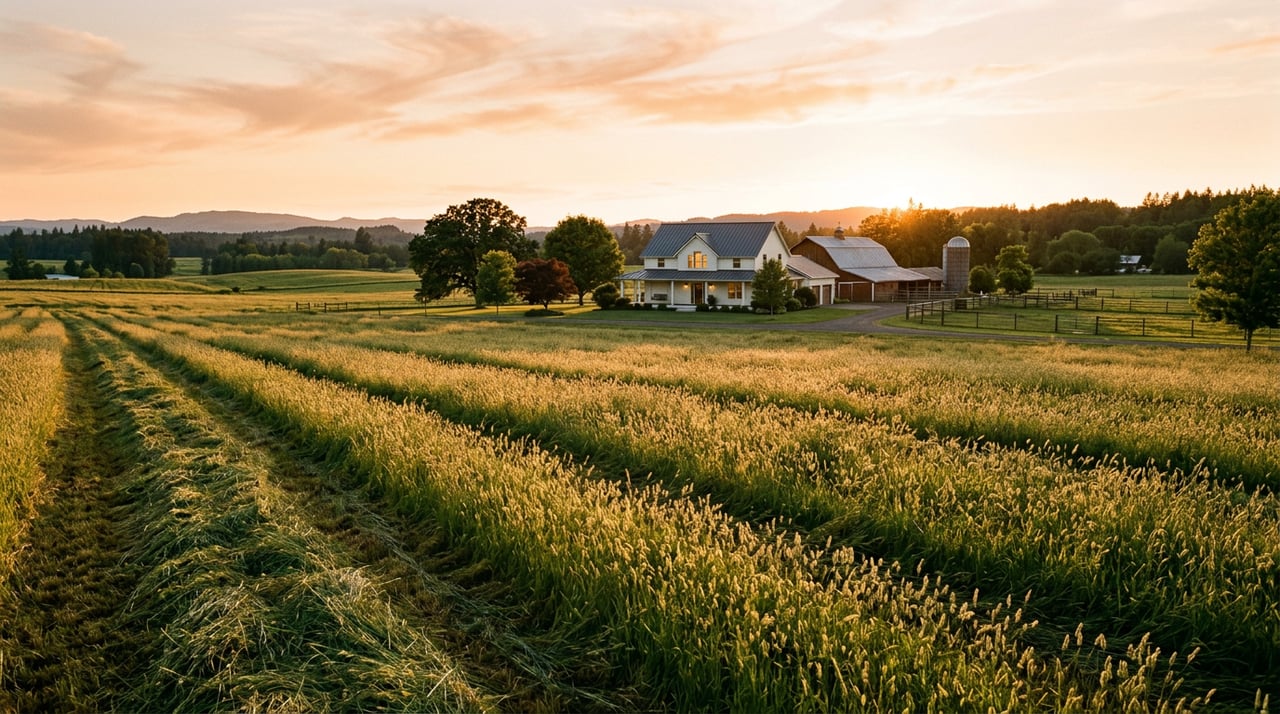
Legacy ranches. These are the properties driving the top of the range. The 1,265-acre ranch on US-95 combines 450 irrigated acres with over a mile of Little Weiser River frontage and hay ground. Cuddy View Ranch offers 224 acres below Cuddy Mountain with entitlement for up to five residences across two parcels. Goodrich Creek Ranch & Retreat runs 227 acres against Payette National Forest with more than a mile of Goodrich Creek. These properties are priced against irrigated acreage, water rights, and legacy production value, not per-square-foot comps.
Recreational retreats. Mid-range acreage tied to hunting, timber, or creek frontage. A 100-acre estate on the Highway 71 corridor with Pine Creek running through, hillside seclusion, and Hells Canyon access sits in this bucket. So does a 40-acre home site with Cuddy and Council Mountain views. Pricing here reflects location, terrain, and view corridors more than the house itself.
Building parcels. Twenty-acre lots with entitlement work underway. The Valley View Ranch Lots, named after the old Valley View school site under Cuddy Mountain, offer three roughly 20-acre parcels plus two ag lots suitable for alfalfa, grass hay, or pasture. A 10.1-acre parcel currently on the market carries a brand new well, completed septic permit work, and power to the post. That last detail matters. In a drought-declared year, a parcel that has already cleared its septic evaluation is worth measurably more than a raw parcel of the same size and view.
In-town and edge-of-town residential. The smallest and least represented bucket. A six-bedroom home on 1.9 acres at the edge of town, a custom home on nearly six acres bordered by Rush Creek. These are the closest thing Cambridge has to a conventional residential comp, and there are rarely more than a handful listed at once.
If you know which bucket you are in, the Cambridge market is legible. If you compare across buckets, it looks broken.
Water rights are a separate deed
Idaho treats water rights as a distinct form of property. They are governed by prior appropriation, often summarized as first in time, first in right, and they do not automatically transfer with land. A deed alone does not guarantee that water rights convey. The purchase agreement, deed language, and recorded transfer documents must clearly identify which rights are included. Rights that have gone unused for an extended period can also be subject to forfeiture under Idaho law.
For an in-town Weiser bungalow, this is usually a non-issue. For a Cambridge parcel with irrigated pasture, a stock pond, or creek frontage, it is the single most consequential piece of the transaction. The Idaho Department of Water Resources maintains a public water right and adjudication search that lets you verify the exact right numbers, priority dates, source, and current owner of record.
A few Cambridge-specific patterns worth understanding before you write an offer on acreage:
- The domestic well exemption in Idaho allows one household up to a half-acre of irrigation and roughly 13,000 gallons per day. That is a household allowance, not a working-land allowance. Pasture, orchard, or hay ground beyond that half-acre needs a separate surface or groundwater right.
- Priority date is the whole game during a shortage. A junior priority date can be curtailed while an older senior right on the neighboring parcel keeps flowing. In a drought-declared 2026, that hierarchy stops being abstract.
- Riverfront does not equal water access. Being next to the Weiser or Little Weiser River does not grant a right to divert from it.
This is the layer that makes rural West Central Idaho transactions different from suburban ones, and it is the layer most likely to cause a post-closing dispute if it is handled loosely at contract.
How to actually shop this market
If you have decided Cambridge is the right community and you are trying to translate the listings into a plan, the sequence matters more than the price filter.
- Decide your bucket before you set a price ceiling. A $600,000 building parcel and a $600,000 residence with acreage are not the same asset.
- On any acreage or agricultural parcel, pull the water rights record from the IDWR search before you write the offer. Confirm the right numbers, priority date, and whether they are appurtenant to the land or held separately.
- On any raw or partially improved parcel, ask what stage the septic evaluation has reached. In a 2026 drought year, a completed site evaluation is a real asset. An unstarted one is a schedule risk.
- Budget for a well and septic mortgage survey even if the lender has not yet demanded one. It is inexpensive due diligence relative to the cost of finding a problem later.
- Read days on market by bucket, not in aggregate. A legacy ranch trading in 300 days is normal. A building parcel with completed permits sitting for 300 days is telling you something specific about pricing.
The 268-day median is not a warning about Cambridge. It is a byproduct of a small inventory made up mostly of specialized properties that require the right buyer, the right financing, and the right season. When the match happens, it happens quickly.
FAQ
Is Cambridge a buyer's market or a seller's market right now? Neither label fits well. Idaho statewide is forecast for 2 to 5 percent price growth in 2026 with mortgage rates in the low-to-mid 6% range, and the market is broadly stable. Cambridge specifically is illiquid, meaning both sides have leverage in narrow windows. A well-priced building parcel with entitlements moves. A ranch priced against ambition rather than comparable sales can sit for a year.
Do I need a water rights attorney to buy acreage in Cambridge? Not always, but you need the water rights researched and the conveyance language reviewed before closing. On complex parcels with irrigation, multiple sources, or unclear priority, specialized counsel is money well spent. On a small parcel served only by a domestic well, careful contract language and an IDWR record pull are often sufficient.
Will the 2026 drought declaration affect existing homes? Existing wells and septic systems are not being reissued. The tighter scrutiny applies to new site evaluations for new septic construction. If you are buying an established home with a functioning system, the drought declaration matters mainly for outdoor water use and any future expansion plans.
How current are the Cambridge listing counts? Small-market inventory changes week to week. The 17 to 38 range reflects different aggregators sampled in mid-2026. The shape of the market, four distinct property types averaged into one median, is the stable observation.
Cambridge rewards buyers who slow down long enough to read the parcel, the water, and the permit stage before they read the price. If you are trying to translate a Cambridge listing into a plan you can actually close on, Malia Bumgarner at Creed Noah Real Estate has walked this ground and this paperwork for a couple of decades. Let's connect.